
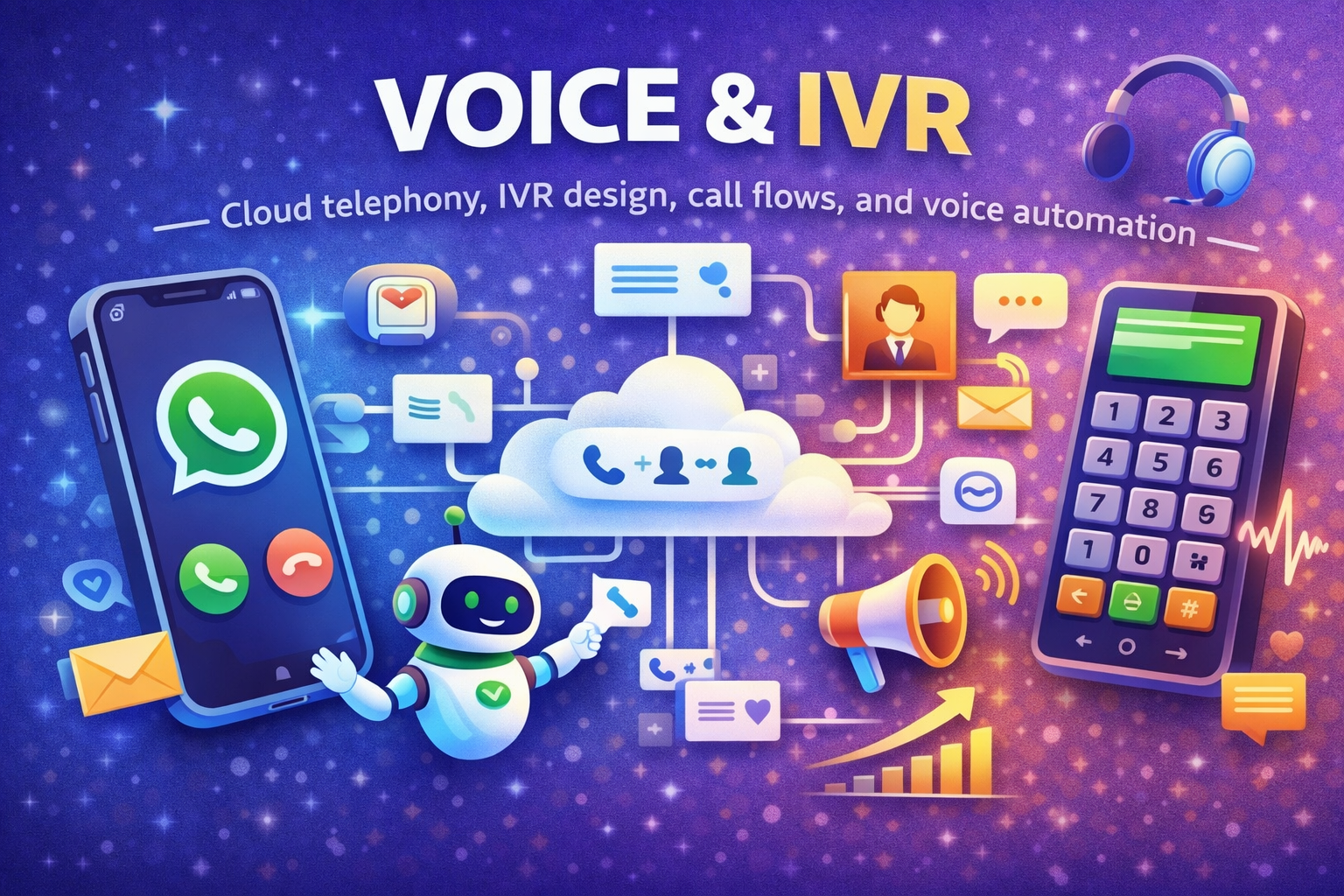
📞 What is Cloud Telephony?
Cloud telephony is a modern communication system that allows businesses to manage voice calls over the internet instead of traditional phone lines. It eliminates the need for physical hardware and enables companies to handle calls using cloud-based platforms.
With cloud telephony, businesses can:
- Make and receive calls from anywhere calls from anywhere
- Scale communication without infrastructure costs
- Integrate voice services with CRM and applications
- Monitor and analyze call performance
This makes it an essential part of modern CPaaS solutions.
🎛️ What is IVR (Interactive Voice Response)?
IVR (Interactive Voice Response) is an automated system that interacts with callers through pre-recorded voice prompts and keypad inputs
It allows customers to:
- Navigate menus (Press 1 for Sales, Press 2 for Support)
- Access information without human assistance
- Get routed to the right department quickly
IVR improves efficiency while reducing the workload on support teams.
⚙️ How IVR Systems Work
An IVR system follows a structured process:
Common automation features:
- 📲 Incoming call is received
- 🎧 Pre-recorded greeting is played
- 🔢 User selects options using keypad or voice
- 🔀 System routes the call based on input
- 👨💼 Call connects to agent or automated response
This entire flow is managed through cloud telephony infrastructure.
🧠 IVR Design Best Practices
A well-designed IVR system ensures better user experience and faster resolution.
Key best practices include:
- Keep menu options simple and limited
- Use clear and professional voice prompts
- Provide an option to speak to a human agent
- Minimize call waiting time
- Support multi-language options
A good IVR design reduces call drop rates and improves customer satisfaction.
🔄 Call Flows Explained
Call flow refers to the journey a caller takes within the IVR system — from entry to resolution.
Example of a simple call flow:
Welcome message → Language selection → Department selection → Agent connection
Advanced call flows may include:
- Time-based routing (office hours vs after hours)
- Skill-based routing (connecting to the right expert)
- Priority routing for VIP customers
Proper call flow design ensures efficient handling of large call volumes.
🤖 Voice Automation in Business Communication
Voice automation uses AI and predefined workflows to handle calls without human intervention.
It enables:
- Automated customer support
- Voice bots for FAQs
- Appointment booking via calls
- Payment reminders and alerts
Voice automation helps businesses operate 24/7 while reducing operational costs.
🎯Use Cases of Voice & IVR
🏦 Banking & Finance
- Balance inquiries
- Fraud alerts
- Loan support
🛒 E-commerce
- Order confirmation calls
- Delivery updates
- Customer support
🏥 Healthcare
- Appointment scheduling
- Reminder calls
- Emergency support
🏡 Real Estate
- Lead qualification
- Property inquiries
- Follow-up calls
📊 Benefits of Voice & IVR Systems
- 📞 24/7 customer support
- ⚡ Faster call handling
- 💰 Reduced operational costs
- 📈 Improved customer experience
- 🔄 Scalable communication system
🌐 Voice & IVR in CPaaS Platforms
In CPaaS, voice and IVR APIs allow businesses to integrate calling features directly into their applications. This enables automation, analytics, and seamless communication across channels like SMS, WhatsApp, and email.
🏁 Conclusion
Voice and IVR systems are transforming business communication by combining automation with efficiency. With cloud telephony, businesses can scale operations, improve customer experience, and reduce manual workload.
By implementing smart IVR design and voice automation, companies can deliver faster, smarter, and more reliable communication. 🚀

Orbitel is an enterprise CPaaS platform enabling secure, scalable, and compliant communication across SMS, Voice, WhatsApp, Email, and RCS for businesses operating at scale.
Talk to Orbitel Sales
Tell us about your communication needs and our team will get back to you within 24 hours.